I spent the last few days at
Fiber College in Searsport, Maine. What an amazing time!
Here are some pictures of the
Searsport Shores Ocean Campground, where Fiber College is held.
I stayed in their honey bee bunk house. The first night there was one other person with me, who wasn't talkative. The second night I chatted with Donna and
Jen - both bright beautiful souls who have a lot to share! The whole experience was amazing. I'm planning on spending longer there next year.
There are beautiful gardens, and this really awesome fence.
A couple friendly angora goats.
The beautiful beach, where I really enjoyed doing some yoga and
listening to the waves on Friday morning.
As part of Fiber College, I took a natural dying class with
Jackie Ottino Graf (who's also the dye-queen at
Swans Island Yarns). I'm
feeling so inspired to start a dye garden and play with dying things
naturally. It was a very inspiring class!
Jackie, sharing her knowledge with the class.
Yarn and fiber soaked overnight in potassium alum sulfate mordant with some cream of tartar.
A variety of plants and extracts that can be used for dying, including goldenrod, brazilwood, dyers chamomile, onion skins, madder, logwood, cochineal, pomegranate, and a bunch more.
Goldenrod
Dyer's chamomile
Yellow medley of goldenrod, dyer's chamomile and weld.
Result of the yellow plant medley.
Dried cochineal beetles. This won't be something I use, as I don't like the idea of killing the beetles to make a red dye, but it was in the class, and seeing the red it created was pretty impressive.
White yarn dipped into cochineal.
Cochineal yarn dripped orange into the white basin. We all found that a bit amusing.
Yellow medley yarn dipped into the cochineal to create a variegated colorway.
We forgot to put the ring on this one.
Pomegranate (back); logwood purple (front)
Logwood purple results on fiber.
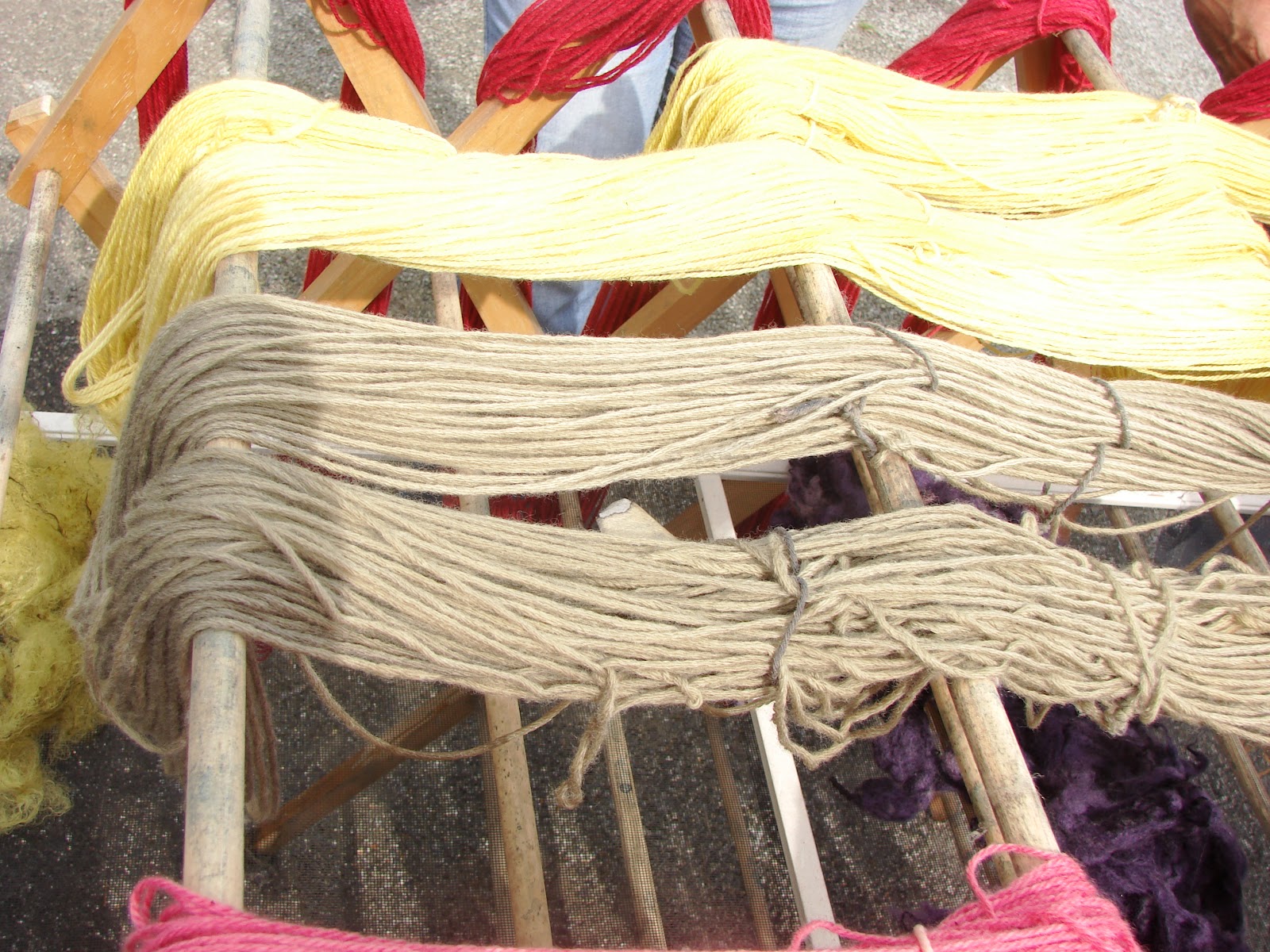
Yellow medley, cochineal, longwood purple and pomegranate.
Pomegranate; variegated yellow medley and cochineal; yellow medley.
Pomegranate in the iron after-dip.
Pomegranate with an iron after-dip makes a sage green… who'd-a-thunk-it?
Yellow medley fiber (back) dipped into the pomegranate/iron blend (front).
madder root
Yellow medley fiber dipped into the madder. LOVE this color!
A day's work.
Notes.
Friday I checked out the vendors. Some of them brought animals with them! There were sheep and llamas. That li'l llama wasn't too sure what to think of me taking pictures.
I also took a hula hooping class with
Jen Appleby on Friday afternoon. No pictures of that though… I was too busy spinning a hoop around to pick up a camera. TONS of fun!
The toys I returned home with!
Lots of dye, yarn and fiber for me to play with!
Natural dye extracts from Jackie, and some Dye For Me yarn that I got a great deal on from the Heavenly Socks yarn store in Belfast. They had ordered it for another customer, but she ended up not wanting it. Lucky me!
A Wrinkle in Thyme yarns. This farm is about a half hour from my house!
I'll be visiting them, for sure!
Fiber College is still going on - through Sunday September 9th. If you're in the Searsport, Maine area, I highly recommend checking them out! If you miss this one, there's always planning for next year. I know I will be! See you there?






 Then, just for fun, and to see an alternative option, I tried the basket pattern again with a little white accent. I submit both options to Quince & Co to let them decide which version they preferred.
 I enjoyed knitting and writing the pattern for this sweater quite a bit. It worked up SO fast, and Osprey is such a beautiful yarn to work with. The biggest challenge I faced with this design was maintaining the star pattern while increasing and decreasing. After a little trial and error, I came upon the perfect solution. Of course, it's all written out in detail in the pattern!


